
Medical Representative Daily Call Report Format: Free Template, 3 Examples, and Sample Rules
A DCR format for doctor, chemist and stockist calls, a spreadsheet you can download, three filled-in examples, and what to record when you give samples.
A clinic waiting room, 11:20 a.m. You’ve read the health poster twice and a magazine from 2023 once, and you now know the receptionist’s ringtone by heart. Somewhere behind that door is your fourth doctor of the day. Your DCR still has three empty rows from this morning.
If you’ve never filled in a DCR from memory at 10 p.m., you’re either very disciplined or in your first week. A good medical representative daily call report format turns that waiting time into the five minutes that matter. It records every call you make in a day: which doctors, chemists and stockists you met, what you detailed, which samples you gave, what was ordered, and when you’ll go back.
Below is a free DCR template you can copy, a CSV version for Excel or Google Sheets with one row per call, three examples from different therapy areas and markets, and a plain-English summary of the sample rules in India, the US and the UK. That last section is the one part of this page with no jokes in it, for good reason. If you’re after a general format for one customer meeting, start with our sales visit report template.
What is a daily call report (DCR)?
In pharma, a call is a visit to a doctor, chemist, stockist or hospital, and a daily call report (DCR) is the medical representative’s record of all of them for one working day. Most companies ask for it every evening, usually in their own sales-force app, and managers use it to check coverage, coach reps, and spot supply or competitor problems early.
It’s close to the sales visit report other industries use, and to the daily sales report an FMCG rep sends at the end of the day. What makes the pharma version different is the detail per doctor and the compliance fields. A medical rep is promoting prescription medicines to the people who prescribe them, so what was said, which material was used and which samples changed hands all need a clean record.
India’s Uniform Code for Pharmaceutical Marketing Practices 2024 (UCPMP) is a good example of why. It defines a medical representative as anyone who calls on healthcare professionals, pharmacies, hospitals or healthcare facilities to promote drugs. It makes companies responsible for their reps’ conduct, and it bars reps from using any inducement or trick to get a meeting, or paying for access to a doctor. A DCR that shows what happened on each call is how a company shows it’s following those rules.
The medical representative daily call report format
Copy this into your notes app if you’re drafting between calls, or use it as a checklist for your company’s app. The CSV has the same fields as columns, with one row per call, so a day, a week or a whole cycle fits in one sheet.
DAILY CALL REPORT (DCR)

Date:
MR name:
HQ / territory:
Area worked:
Work type: Field work / Joint work / Meeting / Training / Leave
Worked with:

DOCTOR CALLS (one block per doctor)
Time:
Doctor, speciality, class (A/B/C):
Clinic or hospital:
Products detailed (in order):
Approved material used:
Feedback and questions:
Samples given (product, strength, quantity):
Sample request / receipt signed: Yes / No
Other inputs given:
Medical query forwarded: Yes / No
Adverse event reported: Yes / No (reference only)
Next call objective and date:

CHEMIST AND STOCKIST CALLS
Name and type:
Our brands in stock: Yes / Low / No
Order booked (POB): quantity, value
Competitor activity:
Follow-up:

DAY SUMMARY
Doctors planned / met:
Chemists and stockists met:
Samples given today (by product):
Total POB value:
Doctors missed, and why:
Market intelligence:
Issues for my manager:

TOMORROW
Area:
First three calls (doctor, time):
That’s the format. If you only needed the fields, copy them and get back to your call list. If you’re setting up DCRs for a team, or want yours to survive a manager’s review, the next part explains each one.
What goes in each field, and why
| Field | What to write | Why it matters |
|---|---|---|
| Work type, worked with | Field work, joint work with your manager, a meeting, training or leave. | Explains a low call count before anyone asks, and records joint working for coaching. |
| Doctor, speciality, class | Full name, speciality and the class your company assigns by potential. | Coverage is measured against the class. Missing an A-class doctor matters more than a C. |
| Products detailed, in order | Which brands you presented, first to last. | The first product gets the doctor’s attention. The order should follow the cycle plan. |
| Approved material used | The detail aid, leaflet or study reprint you used. | Shows the call stayed within approved materials, which is what compliance will check. |
| Feedback and questions | What the doctor said, ideally in their words, and anything they asked. | It’s the opening line for your next call, and the only field marketing reads closely. |
| Samples and receipt | Product, strength, quantity, and whether a request or receipt was signed. | Sample records are what regulators and auditors look at first. They must match stock. |
| Medical query, adverse event | Yes or no, plus the reference number from the system you used. | Proves the question or safety report went to the right team, without patient details in the DCR. |
| Next call objective and date | What you want from the next visit, and when it is. | Turns the call list into a plan, and stops calls repeating the same message. |
| Chemist stock, POB | Whether your brands are on the shelf, and any order booked at the chemist (POB). | A doctor who prescribes a brand that patients can’t find stops prescribing it. |
| Doctors missed, and why | Each planned doctor you didn’t meet, with a reason. | Missed calls should be rescheduled, not forgotten. The reason shows whether to change the plan. |
4 rules for a good doctor call entry
Most of a DCR is doctor calls, and most weak DCRs fail in the same places. These four rules fix the common ones.
1. Write it before the next call
You might see ten doctors in a day. By evening, their questions blur together. Take one minute in the waiting area (you’ll usually have a few, and you’ve already read the magazines) or in the car after each call. It’s the only way the feedback field holds what the doctor actually said.
2. Record feedback, not your impression
“Doctor positive” tells your manager nothing. “Prefers once-daily dosing; asked about elderly patients” tells them what the next call should cover, and tells marketing what doctors in your territory care about.
3. Stay inside the approved material
Record which detail aid or leaflet you used. If a doctor asks about a use, dose or patient group your material doesn’t cover, don’t answer from memory. Log the question and forward it to your company’s Medical Information team, then bring their answer on the next call.
4. Every call ends with an objective and a date
“Revisit next cycle” isn’t a plan. “Tue 27 Oct: bring the Medical Information reply and lead with Brand B” is. A dated objective stops you giving the same pitch three visits in a row.
3 daily call report examples
Here’s the format filled in for three different days. The reps, doctors and brands are made up, and product names are placeholders. Notice that each one records feedback in the doctor’s words, logs samples with a signed request or receipt, explains every missed doctor, and plans tomorrow’s first call with a time.
Example 1Cardio-diabetic portfolio, joint working
Rohan, an MR covering GPs, physicians and chemists from the Pune headquarters, working with his area manager.
- Day
- Tue 13 Oct 2026 · Pune HQ, Kothrud · Joint work with area manager
- Calls
- 11 doctors planned, 9 met · 5 chemists · 1 stockist
- Detailed
- Brand A (telmisartan 40 mg) first, Brand B (metformin SR 500 mg) second, with the approved detail aid
- Key call
- Dr. Kulkarni, consultant physician (A): asked for dosing data in elderly patients. Forwarded to Medical Information, reference noted.
- Samples
- Brand A 40 mg: 2 packs each to Dr. Kulkarni and Dr. Joshi, both entered in the sample register
- Chemists
- Brand B out of stock at 2 of 5 chemists · POB: 10 boxes of Brand A, ₹4,800
- Competitors
- A competitor’s metformin SR is on a 10+1 scheme at three chemists.
- Missed
- Dr. Patil (on leave until Mon 19 Oct), Dr. Shah (clinic closed early). Both moved to next week.
- Tomorrow
- Wed 14 Oct, Karve Nagar. First call 10:00 Dr. Deshpande. Call the stockist about Brand B by 11:00.
- Manager note
- Two A-class doctors say patients can’t find Brand B. The gap is supply, not the doctors.
Example 2Gastro portfolio, solo field day
Fatma, an MR calling on GPs and pharmacies along the north coast of Mombasa.
- Day
- Wed 14 Oct 2026 · Mombasa, Nyali and Bamburi · Field work
- Calls
- 8 doctors planned, 7 met · 4 pharmacies · 1 hospital pharmacist
- Detailed
- Brand C (pantoprazole 40 mg), with the approved leaflet
- Key call
- Dr. Hassan, GP (A): “A smaller pack would suit my short courses.” Logged as feedback for marketing.
- Samples
- None given. Two doctors asked for samples; signed requests collected for delivery on the next visit, per company policy.
- Pharmacies
- Brand C in stock at 3 of 4 · order booked through the distributor: 30 packs, KSh 25,500
- Competitors
- A lower-priced generic has appeared at two pharmacies in Nyali.
- Missed
- Dr. Achieng, away at a conference. Rebooked for Wed 28 Oct.
- Tomorrow
- Thu 15 Oct, Bamburi. First call 09:30 Dr. Omar. Deliver the two requested samples and get receipts signed.
- Manager note
- Third GP this month to ask for a smaller pack. Worth raising with the brand team.
Example 3Hospital calls, with a safety report
Chinedu, an MR covering two private hospitals and their consultants in Port Harcourt.
- Day
- Thu 15 Oct 2026 · Port Harcourt, GRA · Field work
- Calls
- 6 consultants planned, 6 met · 1 hospital pharmacist · 1 procurement officer
- Detailed
- Brand D (amlodipine 5 mg), with the approved detail aid
- Key call
- A consultant cardiologist mentioned a patient who developed ankle swelling on Brand D. Reported through the company safety process the same afternoon; reference number recorded. No patient details in the DCR.
- Samples
- Brand D 5 mg: 2 packs to Dr. Eze, receipt signed
- Hospital
- Brand D is on the formulary. The pharmacist asked for the updated price list; requested from the regional office.
- Procurement
- Next quarter’s tender opens Mon 2 Nov. Documents due by Fri 30 Oct.
- Missed
- None.
- Tomorrow
- Fri 16 Oct, Rumuokoro. First call 09:00 Dr. Amadi. Chase the price list before noon.
- Manager note
- Need the tender pack and a signed price list by Wed 28 Oct to make the deadline.
Samples and compliance: what to record
Samples are the part of a DCR most likely to be audited. The rules depend on where you work, and your company’s policy may be stricter than any of them. Here’s how three sets of rules compare, summarised from India’s UCPMP 2024 (section 5), the US regulation 21 CFR 203.31, and Clause 21 of the 2024 ABPI Code in the UK:
UCPMP 2024, section 5India
- Who receives
- Only a person qualified to prescribe the product, handed to them directly or to someone authorised for them.
- Records at handover
- The prescriber’s name and address noted for records.
- Quantity limits
- At most 12 sample packs per drug per doctor per year. Each pack no larger than the smallest pack on the market.
- Company records
- Product, doctor, quantity and date of each supply. Total sample value capped at 2% of domestic sales a year.
21 CFR 203.31United States
- Who receives
- A licensed practitioner, or a hospital or health care entity pharmacy at the practitioner’s written request.
- Request and receipt
- A signed written request before delivery, and a signed receipt at delivery (name, drug, strength, quantity, date).
- Quantity limits
- No per-doctor cap in this section. Follow company policy.
- Company records
- Signed receipts returned to the manufacturer or distributor.
ABPI Code 2024, clause 21United Kingdom
- Who receives
- Handed directly to the health professional who asked, or a person authorised to receive them.
- Request
- A signed and dated written request (electronic signatures accepted), kept for at least a year.
- Quantity limits
- At most four samples of a medicine per health professional per year, and only for two years after their first request.
- Company records
- Systems must show how many samples each health professional has received.
UCPMP adds a few rules that are easy to miss: samples are only for building awareness of treatment options and experience with the product, each sample pack should cover no more than three patients’ course of treatment, every sample must be marked as a free sample not for sale, and companies may not give samples of hypnotics, sedatives or tranquillisers at all.
Whatever your market, the DCR habits that keep you safe are the same:
- Record the product, strength, quantity, doctor and date for every sample, at the time you hand it over.
- Get the request or receipt signed when your rules require it, and note that you did.
- Keep your DCR entries and your sample stock in step. Any gap will show at the next stock check.
- Never record a sample given to someone who isn’t qualified to prescribe it. Don’t give it either.
Not legal advice. This is a summary to help you structure a DCR. Your company’s standard operating procedures are the rules you follow, and they often go further than the codes above.
Side effects and patient details
If a doctor mentions a side effect, a product complaint or a patient problem during a call, report it through your company’s safety (pharmacovigilance) process straight away. Don’t wait for the evening DCR. Then record in the DCR only that a report was made and its reference number. Never write patient names or other identifying details in a DCR, a notes app or a voice memo.
From daily calls to monthly coverage
One DCR shows a day. A month of them shows whether you’re seeing the right doctors often enough. If you keep DCRs in the CSV, one row per call, three numbers are worth checking each week:
- Coverage by class. Of the A-class doctors on your list, how many have you met this month? Then B and C. Your company sets how often each class should be seen.
- Missed doctors. How many planned calls didn’t happen, and was each one rebooked?
- Chemist stock-outs. Which brands were missing, where, and for how long? A doctor who prescribes a brand patients can’t find will stop prescribing it.
In Excel or Google Sheets, a pivot table with Customer name in Rows, Call type and Class as filters, and a count of calls in Values gives you coverage by doctor in a minute. Sort by count to see who you’ve been neglecting.
What managers check in a DCR
First-line managers read DCRs to coach, not just to count. These are the patterns that stand out:
- Identical feedback for every doctor. Usually a sign the report was filled in from memory, or copied.
- Samples that don’t match stock. The first thing an audit will find, and the hardest to explain later.
- Calls with no next objective. The rep is visiting, but not moving any doctor forward.
- A-class doctors missing for weeks. Often a sign of access problems the rep hasn’t raised.
- Supply problems mentioned once and dropped. If a stock-out is in Monday’s DCR, it should be in Tuesday’s too, until it’s fixed.
Common DCR mistakes
- Filling it in at 10 p.m. The doctors blur, the feedback goes generic, and sample counts get rounded.
- “Detailed all products.” Which ones, in what order, with which material? The order is the point.
- Skipping chemist calls. The chemist tells you whether the doctor’s prescriptions are being filled. That’s half the story.
- Patient details in the notes. They don’t belong in a DCR, and they create a privacy problem you don’t want.
- Hiding missed calls. A missed doctor with a reason is information. A missed doctor nobody mentions is a gap in coverage that grows.
Logging calls by voice between clinics
Typing a full doctor entry on a phone in a waiting room is slow, especially with one ear on the receptionist in case your name comes up next. That’s why DCRs drift to the evening. Speaking it takes under a minute if you follow the template order: doctor, time, products, material, feedback, samples, next call. Here’s the first doctor call from example 1, as a voice note:
Dr. Kulkarni, Kothrud clinic, consultant physician, A class. Ten-fifteen. Detailed Brand A first, then Brand B, with the detail aid. She asked for dosing data in elderly patients, so I’ve forwarded that to Medical Information. Two packs of Brand A forty milligram, request signed. Next visit Tuesday the 27th, bring the Medical Information reply and lead with Brand B.
Record it in the car, then transcribe it into your company’s app or the CSV. Keep voice notes to the same rule as the DCR: no patient details, and side effects go through the safety process, not into a memo.
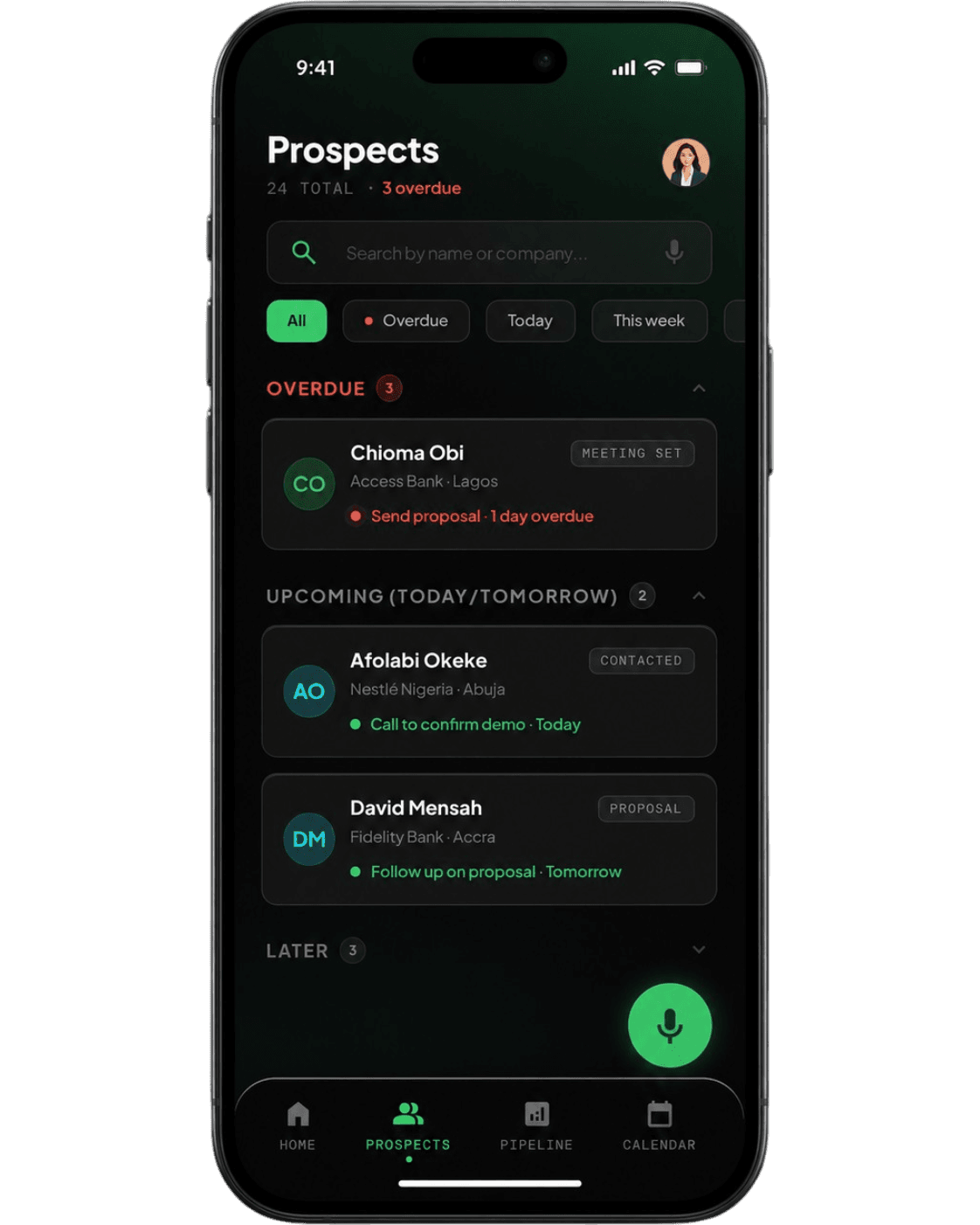
That’s what we’re building Closum for. You record a short update after each call, and it pulls out who you met, what was discussed, the next step and its date for you to check and save. It doesn’t replace your company’s sample register or safety reporting, but it means the rest of your DCR is mostly written by the time you reach the next clinic. See the teams it’s built for.
Medical representative daily call report FAQ
What is a DCR in pharma?
DCR stands for daily call report. It’s the record a medical representative submits at the end of each field day, listing every doctor, chemist and stockist call: who you met, what you detailed, samples given, orders booked, and the plan for the next call.
What should a medical representative write in a daily call report?
For each doctor: time, name, speciality and class, products detailed in order, the approved material used, feedback, samples given and whether a request or receipt was signed, and the next call objective and date. For chemists and stockists: stock of your brands, orders booked and competitor activity. Then a day summary and tomorrow’s first calls.
How many doctor calls should a medical rep make per day?
There’s no single industry number. Companies set their own daily norms by territory, speciality and portfolio, and hospital calls take longer than clinic calls. Follow your company’s norm, and track coverage of your doctor list by class, which says more than the daily count.
What is POB in a DCR?
POB usually stands for personal order booking: an order the MR books directly at a chemist or stockist during a call, recorded with quantity and value. Not every company uses the term, and some don’t ask MRs to book orders at all.
How should samples be recorded in a DCR?
Record the product, strength, quantity, the doctor’s name, the date, and whether a request or receipt was signed, exactly as your company’s sample policy requires. Your entries should match your sample stock, and the rules differ by country.
What if a doctor reports a side effect during a call?
Report it through your company’s safety (pharmacovigilance) process straight away, using the official form or line. Don’t wait for the DCR. In the DCR itself, note only that a report was made and its reference number, with no patient details.
Can I keep my DCR in Excel?
Yes, if your company doesn’t require a specific system. Download the CSV above, keep one row per call, and filter by doctor, class or date. Many companies require their own SFA or CRM app for DCRs and sample records, so check before you switch.