
Daily Sales Report Template: Free Excel Format, 4 Examples, and a 2-Minute Routine
A one-screen format for the end of every field day, a spreadsheet with formulas for weekly totals, and four filled-in examples from FMCG, insurance, B2B and real estate.
6:47 p.m. Last visit done. The car park is emptying, your phone is on 9%, and a message from your manager has just landed: “Pls send today’s report.” Twelve visits, three orders, one long conversation about a late delivery van, and you can remember about half of it.
(It’s always “pls”. Nobody has the time for the other three letters.) This free daily sales report template is built for exactly that moment. It fits on one phone screen: what you did today, what it produced, what got in the way, and where you start tomorrow. Fill it in before you leave the last customer and it takes two minutes. Leave it until the next morning and it turns into guesswork.
Now the useful part. Below you’ll find the template to copy, an Excel file with the formulas already built in (plus a CSV for Google Sheets), a combined format for people who do both sales and marketing, and four examples filled in by reps in different industries. It works on its own, or as the roll-up of your individual sales visit reports.
What is a daily sales report?
A daily sales report (also called an end-of-day report, a daily activity report, or in FMCG and pharma a daily call report) is a short summary a sales rep sends at the end of each working day. It records the day’s activity, the results it produced, the problems that came up, and the plan for the next day.
It’s different from a sales visit report, which covers one meeting in detail. The daily report is the roll-up: twelve visits become a few numbers and a handful of lines that a manager can read in under a minute.
Done well, it saves time on both sides. The rep closes the day with a plan instead of a vague worry about what was promised to whom. The manager sees the whole team’s day without a dozen phone calls. Done badly, it’s one more admin task, and reps already have plenty: Salesforce’s 2024 State of Sales survey of 5,500 sales professionals found reps spend 70% of their time on non-selling tasks. A daily report has to be quick to fill in and worth reading, or it shouldn’t exist.
The daily sales report template
Copy this into your phone’s notes app, an email to your manager, or a WhatsApp message. The spreadsheet version has the same fields as columns, one row per rep per day, so a week or a month of reports stacks up in one sheet.
DAILY SALES REPORT

Date:
Rep:
Territory / route:

ACTIVITY
Visits planned:
Visits completed:
Phone calls made:
New prospects added:
Km travelled:

RESULTS
Orders taken:
Order value:
Payments collected:
Quotes sent:
Meetings or demos booked:

WHAT HAPPENED
Best result today:
Biggest blocker:
Competitor activity:
Visits missed, and why:

TOMORROW
First visit (who, where, time):
Top 3 priorities:
Follow-ups due:

I need help with:
If the template was all you came for, you’re done. Copy it and enjoy whatever evening the traffic leaves you. The rest of this page is for anyone who wants their report to actually get read.
What goes in each field, and why
| Field | What to write | Why it matters |
|---|---|---|
| Date, rep, territory | The day, your name, and the route or area you covered. | Lets a manager filter by rep, area and week without asking. |
| Visits planned vs. completed | Two numbers: how many you planned this morning and how many you actually did. | The gap is the most honest number in the report. It shows whether the plan or the day was the problem. |
| Phone calls, new prospects | Calls made and new names added to your list. | Tomorrow’s pipeline. A rep who adds no prospects for a week is living off old accounts. |
| Km travelled | Distance driven, from your odometer or map app. | Most companies need it for fuel claims, and it shows when a route is badly planned. |
| Orders, value, collections | Number of orders, their total value and currency, and cash or transfers collected. | The results half of the report. Values add up across reps; adjectives don’t. |
| Quotes, meetings booked | Quotes sent and meetings or demos booked, for longer sales cycles. | In B2B, insurance and real estate, these move before orders do. |
| Best result today | One line on the day’s win, with a number if there is one. | Gives the manager something to repeat to the team, and keeps morale honest. |
| Biggest blocker | The one thing that cost you the most sales today. | It’s the field a manager can act on. Leave it blank and nobody can help. |
| Competitor activity | Promotions, prices, credit terms or new products you saw. | Across a team, these lines are a free weekly market report. |
| Visits missed, and why | How many, and the reason: shop closed, customer cancelled, ran out of time. | Separates bad luck from bad routing, and stops missed visits disappearing. |
| Tomorrow | The first visit with a time, your top three priorities, and follow-ups due. | Turns the report from a look back into a plan for the morning. |
| I need help with | A specific ask: a price approval, stock, a credit decision, an introduction. | The line that makes a daily report a conversation instead of paperwork. |
Daily sales report format: 5 rules that keep it useful
The fields are the easy part. These rules decide whether anyone, including you, gets value from the report a week later.
1. Same fields, same order, every day
A daily report only becomes useful when you can line up twenty of them. Keep the fields fixed, keep numbers as numbers, and resist adding a new box every time something interesting happens. That’s what the free-text lines are for.
2. Write it before you leave the last customer
The details that matter most (the exact objection, the competitor’s price, the name of the person who needs to approve) are the first to fade. Five minutes in the car park beats twenty minutes at home trying to remember which shop said what.
3. Pair every activity number with a result
Twelve visits sounds busy. Twelve visits and one order is a problem worth talking about. Twelve visits and nine orders is a route worth copying. The report needs both halves to tell those days apart.
4. One blocker, one ask
Ask for the single biggest thing that cost you sales today, not a list of complaints. Then ask for one specific thing you need: a price approval, stock, a credit decision. A manager can act on one clear ask the same evening. A paragraph of frustration usually waits until Monday.
5. End with tomorrow’s first visit
Write down who you’ll see first tomorrow, where, and at what time. It sounds trivial, but specific plans get carried out more often than vague ones. Gollwitzer and Sheeran’s 2006 meta-analysis of 94 independent tests found that “if-then” plans, which spell out when and where you’ll act, had a medium-to-large effect on reaching goals. “Mama Ngozi Provisions at 08:30” is that kind of plan. “Visit some outlets in Area 11” isn’t.
4 daily sales report examples
Here’s the template filled in by four reps in four industries. The people and businesses are made up; the shape is what matters. Notice that each one has a number for every activity, a single blocker, a specific ask, and a dated first visit for the next day.
Example 1FMCG route sales rep
Amaka, a beverage company rep serving shops and kiosks on a fixed route in Abuja.
- Day
- Thu 15 Oct 2026 · Wuse–Garki route, Abuja
- Activity
- 14 outlets planned, 12 visited · 3 phone orders · 2 new outlets signed · 58 km
- Results
- 9 orders (9 of 12 visits productive) · ₦486,000 · ₦210,000 collected
- Best result
- Corner Mart reordered 25 cartons after three weeks out of stock.
- Blocker
- The distributor’s van arrived at 1 p.m. instead of 9 a.m. Two outlets wouldn’t wait.
- Competitors
- A rival 500 ml brand is running buy-5-get-1 at 4 outlets on this route.
- Missed
- 2 visits: one shop closed (owner travelling), one moved to Friday.
- Tomorrow
- Fri 16 Oct, 08:30 Mama Ngozi Provisions, Area 11. Confirm van time first, restock the 4 outlets that missed delivery, pitch 2 new outlets.
- Need help
- Can we match buy-5-get-1 at those 4 outlets, or offer a counter display deal?
Example 2Insurance agent
Kofi, a life insurance agent meeting families and small business owners in Kumasi.
- Day
- Wed 14 Oct 2026 · Adum and Asokwa, Kumasi
- Activity
- 5 appointments planned, 4 held · 11 phone calls · 3 referrals collected
- Results
- 1 education plan signed (annual premium GH₵3,600) · 2 quotes sent · 1 needs review booked for Sat 17 Oct
- Best result
- The signed client gave two referrals without being asked.
- Blocker
- Two prospects want to wait for their December bonuses before committing.
- Competitors
- A bank offered one prospect a policy bundled with a personal loan.
- Missed
- 1 appointment: client rescheduled to Fri 16 Oct.
- Tomorrow
- Thu 15 Oct, 09:00 Mr. Owusu at his Adum shop to sign the proposal form. Then call the 3 referrals.
- Need help
- Underwriting to confirm whether a 52-year-old applicant needs a medical exam.
Example 3B2B industrial equipment rep
Thandi, who sells compressors, parts and service contracts to factories east of Johannesburg.
- Day
- Tue 13 Oct 2026 · Isando and Germiston
- Activity
- 4 site visits planned, 4 completed · 6 phone calls · 1 new prospect · 112 km
- Results
- 1 parts order, R48,500 · 2 quotes sent, R310,000 combined · 1 demo booked for Tue 20 Oct
- Best result
- A packaging plant asked for a quote on two new units after a breakdown last week.
- Blocker
- Their plant manager is on leave until Mon 19 Oct, and purchasing won’t sign without him.
- Competitors
- A competitor offered the same plant a free six-month service plan with any new unit.
- Missed
- None.
- Tomorrow
- Wed 14 Oct, 07:30 site walk-through at a bottling plant in Germiston. Send the service-plan comparison by noon.
- Need help
- Can we offer an extended warranty to answer the free service plan?
Example 4Real estate agent
Wanjiku, a residential agent handling sales listings in Kilimani and Lavington, Nairobi.
- Day
- Fri 9 Oct 2026 · Kilimani and Lavington
- Activity
- 3 viewings planned, 3 held · 8 calls · 2 new buyer leads from a listing portal · 1 valuation
- Results
- 1 offer of KSh 14.2M on a 3-bed listed at KSh 15M · 1 second viewing booked · 1 new listing signed
- Best result
- The valuation turned into a signed listing on the spot.
- Blocker
- The buyers behind the offer are still waiting for their mortgage approval letter.
- Competitors
- The Lavington seller is also talking to another agency.
- Missed
- None.
- Tomorrow
- Sat 10 Oct, 10:00 take the offer to the seller, then an open house at 14:00.
- Need help
- A second opinion on the valuation before the new listing goes live.
Pharma reps: a medical rep’s daily call report adds doctor-level detail, sample records and compliance fields that don’t belong in a general template. See our medical representative daily call report format.
Merchandisers and retail reps: for what you find on the shelf at each store (out-of-stocks, facings, prices, displays), use our store visit report template. The daily report then just adds up the stores.
Sales rep daily activity report: activity vs. results
Some companies only ask for a sales rep daily activity report: visits, calls, kilometres. It’s easy to collect and easy to game. A rep can hit twelve visits a day by choosing the friendliest twelve shops. Pairing activity with results closes that gap. These are the ratios worth tracking from the template above:
| Metric | Type | What it tells you |
|---|---|---|
| Visits completed ÷ visits planned | Activity | Whether the day went to plan. A low number every day points at routing or planning, not effort. |
| Orders ÷ visits completed (strike rate) | Result | How many visits turn into business. FMCG teams often call order-taking visits “productive calls”. |
| Order value per day | Result | The number the business runs on. Track it per rep and per route, week on week. |
| New prospects added | Activity | Whether next month’s pipeline is being built today. |
| Quotes and meetings booked | Leading result | Early signals for longer sales cycles, weeks before an order shows up. |
| Days with a blocker logged | Health | Reps who never report a blocker are usually hiding them, not avoiding them. |
There’s no universal “good” number for any of these. A rep restocking existing outlets should convert most visits into orders; a rep opening new accounts won’t. Compare each rep with their own last month, and with others on similar routes, rather than with a target picked from the air.
Daily activity report format for sales and marketing
In smaller companies the same person often sells and markets: an FMCG trade marketer who runs in-store activations and takes outlet orders, a sales development rep who sends email campaigns and books meetings, or a founder doing all of it. A combined daily activity report for sales and marketing keeps both kinds of work in one place, and answers the question a manager actually cares about: which activities turned into leads and sales.
DAILY ACTIVITY REPORT: SALES & MARKETING

Date:
Name / role:

SALES ACTIVITY
Visits or meetings:
Calls made:
Follow-ups sent:
Orders or deals closed:
Value:

MARKETING ACTIVITY
Campaigns or activations run:
Channel (in-store, email, social, event):
Reach (people, emails, impressions):
Leads generated:
Cost or spend:

RESULTS
Leads passed to sales:
Meetings booked:
What worked best today:

Blocker:
Tomorrow's first task:
I need help with:
The rule that makes it work: every marketing activity gets a reach number and a leads number, and every sales activity gets a result. Add the cost next to each, and within a few weeks you can see which activities pay for themselves. In the Excel download, the Sales & marketing sheet logs one row per activity, with a dropdown for the channel.
ExampleOne trade marketer’s day
An activation in the morning, outlet visits in the afternoon.
- Day
- Thu 15 Oct · Ifeoma, trade marketing, Lagos
- Activation
- Bola Supermarket, Allen Avenue: 140 shoppers sampled, 38 bought on the spot
- Cost
- ₦35,000 for samples and a promoter
- Sales
- 9 outlet visits, 6 orders, ₦312,000. The supermarket reordered for ₦54,000.
- Leads
- 3: two outlets asked to stock the pack after the activation, one from outlet visits
- Best result
- Shelf space won at 3 outlets
- Blocker
- The promoter arrived 40 minutes late, at the store’s busiest hour.
- Tomorrow
- Deliver to the 2 new outlets by Fri 16 Oct
- Need help
- A backup promoter for Saturday’s activation
Daily sales report template in Excel or Google Sheets
The Excel template has four sheets:
- Daily reports: the template’s fields as columns, one row per rep per day, with visit completion and strike rate calculated for you.
- Weekly summary: type a Monday and your reps’ names, and each rep’s totals for that week fill in.
- Sales & marketing: the combined activity log from the section above.
- How to use: these instructions, so they travel with the file.
It’s filled with a made-up week for two reps so you can see the formulas working. Delete those rows and start typing. In Google Sheets, use File → Import and upload the Excel file or the CSV. Either way, keep one row per rep per day, and never merge cells or add subtotal rows in the middle of the data: they break filters and formulas. Put totals on a separate sheet.
Formulas to add
The Excel file already includes the first two. The rest are for your own summaries. On the Daily reports sheet (and in the CSV), column A is the date, B the rep, D visits planned, E visits completed, I orders taken, J order value and P the biggest blocker. Replace “Amaka” with a rep’s name, or point it at a cell that holds one.
Visit completion rate (row 2, format as %):
=IF(D2=0,"",E2/D2)

Strike rate: orders per completed visit (row 2):
=IF(E2=0,"",I2/E2)

One rep's order value for the week of Mon 12 Oct 2026:
=SUMIFS(J:J,B:B,"Amaka",A:A,">="&DATE(2026,10,12),A:A,"<="&DATE(2026,10,16))

Days this month one rep logged a blocker:
=COUNTIFS(B:B,"Amaka",P:P,"<>",A:A,">="&DATE(2026,10,1))

Average visits completed per day, one rep:
=AVERAGEIFS(E:E,B:B,"Amaka")
Weekly totals with a PivotTable
For a team summary, a PivotTable does the work without any formulas. Microsoft’s guide to creating a PivotTable covers the steps: select the data, choose Insert → PivotTable, and pick a new sheet. Then:
- Put Rep in Rows.
- Put Visits completed, Orders taken and Order value in Values (each as a Sum).
- Put Date in Filters, and pick the week you want.
Google Sheets works the same way under Insert → Pivot table. Refresh the pivot each Friday and you have a weekly team report that took no extra writing.
For managers: how to read a daily sales report
A daily report is only worth the rep’s two minutes if someone reads it. Reading it well takes a few minutes per team, if you know where to look:
- Read the “I need help with” line first. Answer it before the next morning. Nothing kills reporting faster than asks that go nowhere.
- Scan planned vs. completed. One bad day is noise. The same gap three days running is a routing, stock or motivation problem.
- Look for repeated blockers and competitor lines. Three reps mentioning the same promotion on the same day is a pattern you can respond to this week.
- Check tomorrow’s plan. If the first visit is vague, the morning will be too.
And don’t punish honest blockers. If writing “I lost two orders because the van was late” gets a rep told off, the next report will say “good day” and you’ll lose the information you need most.
Common daily sales report mistakes
- “Busy day, good feedback.” No numbers, no blocker, no plan. It’s the report version of “Fine, thanks”: it reads well and tells nobody anything.
- Activity only. Visits and calls without orders or meetings booked hide the days that went nowhere.
- Writing it the next morning. The details are gone, and so is the evening you could have used to fix tomorrow’s plan.
- Too many fields. If the report needs scrolling on a phone, reps will skip the end, which is where tomorrow’s plan lives.
- Duplicating the CRM. If every visit is already logged, the daily report should pull those totals, not ask the rep to type them again.
The 2-minute end-of-day routine
Remember that 9% battery from the top of the page? Typing twenty fields on it is why daily reports get skipped. Saying them is faster. Before you start the car after your last visit, record a voice note in the same order as the template: activity, results, best result, blocker, competitors, tomorrow, ask.
Here’s Amaka’s report from the first example, as she’d say it:
End of day, Thursday the 15th. Wuse–Garki route. Planned fourteen outlets, visited twelve, nine orders, four hundred and eighty-six thousand naira, two hundred and ten thousand collected. Two new outlets signed. Best result: Corner Mart reordered twenty-five cartons. Blocker: the distributor van came at one, not nine. Competitor running buy-five-get-one at four outlets. Tomorrow I start at Mama Ngozi at eight-thirty. I need a decision on matching that promo.
That’s under a minute of talking. Send the recording to your manager, or transcribe it with your phone’s dictation and paste it into the template. If you already write a visit report after each meeting, the daily report is mostly adding up what you’ve already recorded.
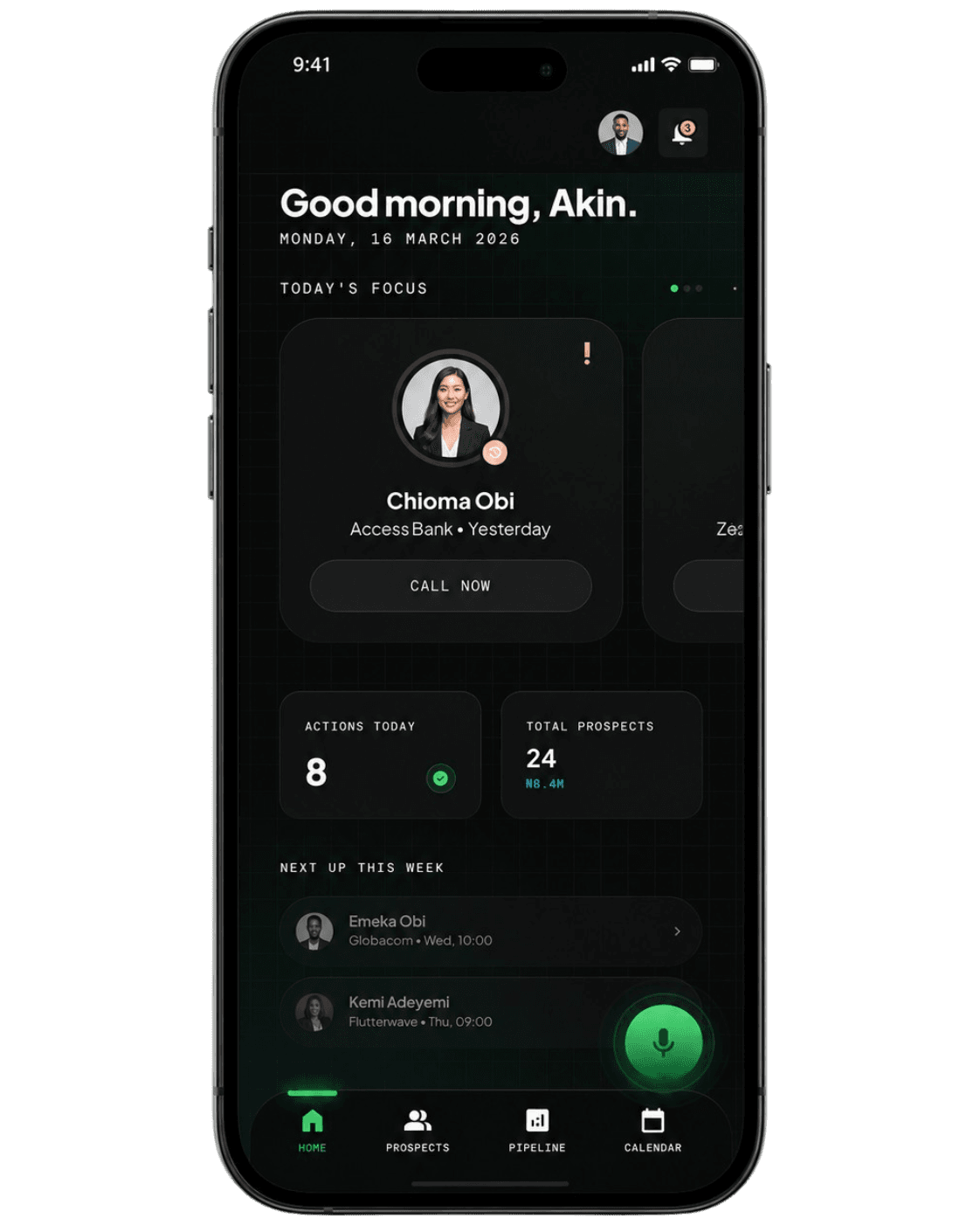
That’s the idea behind Closum. You record a short update after each visit, and it pulls out the prospect, deal value, follow-up date, blocker and pipeline stage for you to check and save. The end-of-day totals and tomorrow’s follow-ups come from those records, so the report is mostly done before you leave the last customer. See how it works.
Daily sales report FAQ
What should a daily sales report include?
Activity (visits planned and completed, calls, new prospects), results (orders, value, payments collected, quotes or meetings booked), the day’s biggest blocker, competitor activity, tomorrow’s first visit and priorities, and one line on what you need help with. Keep it to one phone screen.
What’s the difference between a daily sales report and a sales visit report?
A visit report covers one meeting in detail: who you met, what they need, the outcome and the next step. A daily sales report rolls up the whole day: how many visits, the totals, and the plan for tomorrow. If your visit reports use the same fields every time, the daily report is mostly counting.
What is a sales rep daily activity report?
It’s the activity half of a daily sales report: visits, calls, meetings, new prospects and distance travelled. Some companies ask for activity only. It’s more useful with results alongside, because activity without outcomes can’t tell a busy day from a productive one.
How do I make a daily sales report in Excel?
Download the Excel template above. It has one row per rep per day, completion rate and strike rate already calculated, and a weekly summary sheet that totals each rep’s week. For bigger teams, add a PivotTable. In Google Sheets, use File → Import, then Insert → Pivot table.
What should a daily activity report for sales and marketing include?
Sales activity (visits, calls, follow-ups, orders and their value), marketing activity (campaigns or activations, channel, reach, leads, cost), and the results that connect them: leads passed to sales and meetings booked. Add one blocker and tomorrow’s first task. The Excel template has a sheet for it.
When should reps send their daily report?
Before they finish for the day, ideally from the car after the last visit. Agree a fixed cut-off with your team. Reports written the next morning are reconstructions, and the specifics are the first thing to go.
Is there an app for daily sales reports?
Most CRMs can produce daily activity totals if reps log each visit. Voice-first apps make that logging faster: you speak a short update after each visit and the fields fill themselves. Closum is one of them, built for field sales teams, and it’s in early access now.